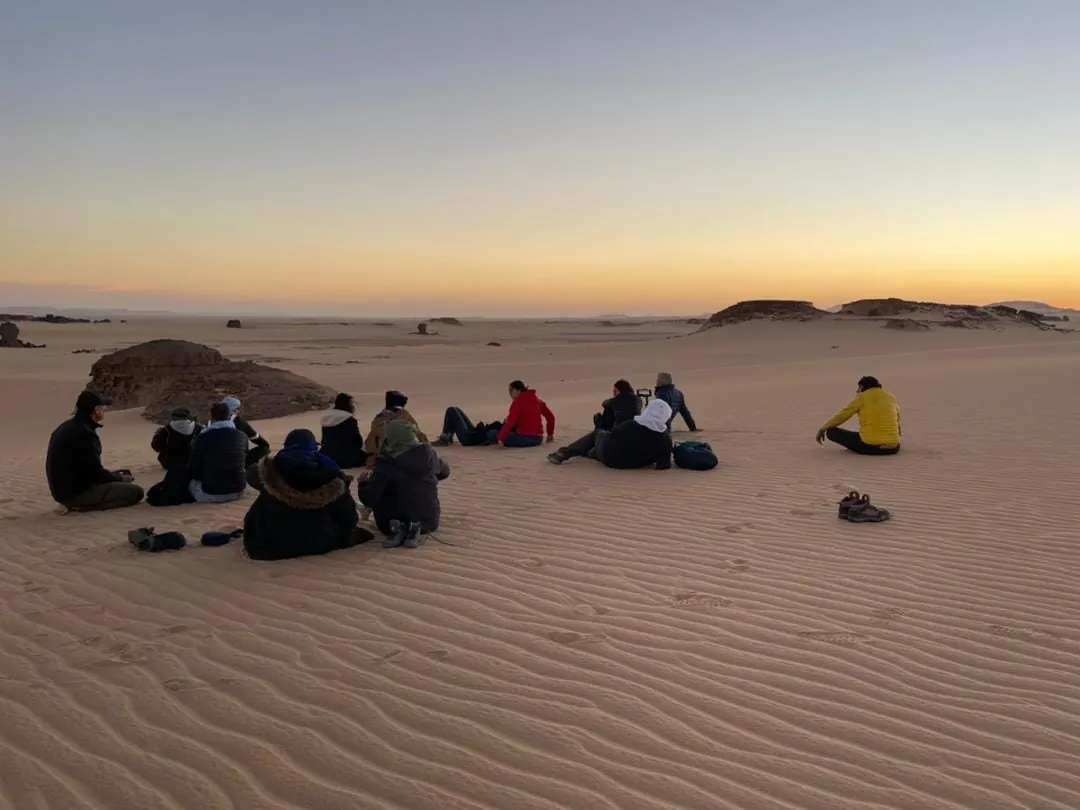
Everything practical in one place: entry formalities, money, climate, getting around, staying connected, local customs, safety and health. Rules change, so we date our checks and link to the official sources.
Checked on 19 October 2026. Visa, entry, customs, safety and health rules can change at short notice. This page is general information for travellers, not legal, immigration or medical advice. Always confirm with the Algerian consulate in your country of residence, your government's travel advice and a travel-health professional before you go.
Visa
Most nationalities need a visa to visit Algeria, and it must normally be obtained before travel from the Algerian consulate or embassy responsible for your place of residence. Holders of diplomatic and service passports are among the few exemptions mentioned by the French government.
- Supporting documents: consulates usually ask for an invitation or a hotel/agency booking, travel insurance covering medical repatriation and emergency care, and proof of means. Once your trip is confirmed, SEFAR Aventure sends the documents you need.
- Visa on arrival for Saharan trips: according to the UK and US governments, a tourist visa may be issued on arrival at some airports when most of your trip is in the south and you have a confirmed reservation with an approved Algerian travel agency. Ask us whether your itinerary qualifies before booking flights.
- Timing and fees: processing times and fees vary by consulate and nationality — apply six to eight weeks ahead.
- Overstaying is an offence that can lead to detention and prosecution; extensions are requested locally (wilaya).
Entry requirements
- A valid visa (or visa-on-arrival authorisation) and a passport meeting the validity rules below.
- Travel insurance with medical repatriation is required for short-stay visas and is mandatory on all our trips.
- Currency declaration: declare foreign currency on arrival and keep the stamped declaration for departure. Official thresholds differ between sources (the US government cites €1,000; the UK government cites €5,000 for declaration at entry and exit), so declare any significant amount.
- Non-residents may not take Algerian dinars out of the country.
- Customs: declare anything that may be prohibited or taxed. Exporting antiquities, fossils or prehistoric artefacts is prohibited and can lead to prosecution; keep proof of purchase for crafts that look old.
- Travellers with Israeli entry stamps may experience difficulties, according to the US government.
Passport
Your passport should be valid for at least six months after your arrival date (UK guidance; the US government also states six months) and have blank pages for the visa and entry and exit stamps. Keep a photocopy and a digital copy separate from the original, and carry your passport in the Sahara — there are routine checkpoints.
Best time to visit
- Sahara: October to April. Best for treks: October–November and March–April.
- North and Roman sites: March to June and September to November.
- Coast: June to September for swimming.
- Avoid the deep south from May to September (extreme heat).
Weather
| Area | Winter (Dec–Feb) | Spring (Mar–May) | Summer (Jun–Aug) | Autumn (Sep–Nov) |
|---|---|---|---|---|
| Algiers & coast | Mild, rainy (≈ 10–17 °C) | Pleasant (≈ 15–24 °C) | Hot, humid (≈ 25–32 °C) | Warm, then rain (≈ 18–28 °C) |
| Constantine & High Plateaus | Cold, occasional snow | Fresh to warm | Hot, dry | Pleasant |
| Djanet & Tassili | Warm days, cold nights (can drop below 0 °C) | Warm to hot | Very hot (often > 40 °C) | Warm days, mild nights |
| Tamanrasset & Hoggar (altitude) | Mild days, freezing nights on the Assekrem | Warm | Hot | Warm |
Figures are indicative averages. In the desert, bring layers: the range between day and night can exceed 20 °C.
Currency and payments
- The currency is the Algerian dinar (DZD).
- Bring euros in cash to exchange at banks, official exchange offices or the airport; keep exchange receipts.
- International bank cards are accepted only in some large hotels and businesses; ATMs accepting foreign cards are limited, mostly in big cities. Do not rely on cards in the Sahara.
- On our trips, accommodation, meals in the desert, transport and guides are prepaid; you only need money for drinks, souvenirs and tips.
- Tipping is appreciated, especially for desert crews.
Transport
- Domestic flights (Air Algérie, Tassili Airlines) are essential for the Sahara; schedules vary by season.
- Trains link the main northern cities; Algiers has a metro, trams and cable cars.
- Roads are generally good in the north; driving is on the right. In the desert, travel by 4x4 with an experienced local driver.
- Taxis are plentiful in cities; agree the fare in advance or ask for the meter.
More in our travel planning guide.
Airports
- Algiers Houari Boumediene (ALG) — the main international gateway.
- Oran Ahmed Ben Bella (ORN) and Constantine Mohamed Boudiaf (CZL) — international and domestic flights.
- Djanet Tiska (DJG) — for the Tassili n'Ajjer and Tadrart Rouge.
- Tamanrasset Aguenar (TMR) — for the Hoggar.
- Ghardaïa Noumérat (GHA), Béchar (CBH) for Taghit, and Timimoun (TMX).
Some Saharan airports also receive seasonal flights from abroad; ask us for the current season's options.
Accommodation
Expect international-standard hotels in the big cities, characterful guesthouses in the oases and simple, comfortable camps in the desert. Hotels register foreign guests with the authorities, so keep your passport at hand when checking in. See accommodation options.
Mobile and internet
- The three mobile operators are Mobilis, Djezzy and Ooredoo. Local SIM cards with data are inexpensive; bring your passport to buy one.
- 4G coverage is good in cities and along main roads, but there is no signal in most desert areas. Our desert teams carry satellite communication.
- Wi-Fi is available in most city hotels; speeds vary. Download offline maps and documents before you go.
- Electricity: 230 V, 50 Hz, European two-pin plugs (types C and F).
Customs and etiquette
- Greet people before asking anything — "Salam aleikoum" or "Bonjour" goes a long way.
- Dress modestly in towns and religious places; shoulders and knees covered for everyone.
- Ask before photographing people, and never photograph military, police or official buildings.
- Use your right hand to eat and to give or receive. Accept tea when offered — it is part of the welcome.
- The weekend is Friday and Saturday. During Ramadan, avoid eating, drinking or smoking in public during the day.
- Alcohol is served only in some hotels and restaurants; be discreet.
Languages
Arabic and Tamazight (Berber) are the official languages. Algerian Arabic (Darja) is spoken daily, and French is widely used in business, signage and education. English is increasingly spoken by young people and in tourism. In the south you will hear Tamasheq, the Tuareg language. Our guides speak French and English; ask us about Spanish-speaking guides for your dates.
Useful words: salam (hello), saha or shukran (thank you), beslama (goodbye), bezzaf (a lot).
Safety
Most visitors find Algerians welcoming and everyday crime levels in tourist areas modest. However, governments publish specific advice for parts of the country, and you should read it before booking because it can affect insurance. Summary as of 19 October 2026:
- United Kingdom (FCDO, updated 25 September 2026): advises against all travel within 30 km of the borders with Libya, Mauritania, Mali and Niger, and within 30 km of the Tunisian border in Illizi and Ouargla provinces and the Chaambi mountains area; against all but essential travel within 30 km of the rest of the Tunisian border.
- United States (State Department, advisory dated 25 August 2026): Level 2 "Exercise increased caution" for Algeria, with Level 4 "Do not travel" for areas near the eastern and southern borders, several southern provinces including Illizi and Tamanrasset, and remote Sahara areas without an organised tour group.
- France (Ministry for Europe and Foreign Affairs): advises against all travel to the south and east of the country (including the regions of Tamanrasset and Djanet) and against non-essential travel to much of the rest of the country, including Ghardaïa province; travel to Algiers, Tipasa, Oran and Tlemcen is possible with vigilance.
Our desert circuits are organised with the required authorisations and accompanied by local guides who follow official guidance; routes are adapted when conditions change. Register your trip with your embassy's traveller service (for example Ariane for French citizens) and check that your insurance covers the regions you visit.
Health
- No vaccinations are listed as required for most travellers by the US government. A yellow fever certificate may be requested if you arrive from a country with risk of transmission — check with your travel clinic.
- The French government recommends being up to date with diphtheria-tetanus-polio; hepatitis A and B and typhoid vaccines are to be discussed with your doctor; rabies vaccination may be considered for long stays. There is no preventive malaria treatment recommendation, but see a doctor for any fever.
- Drink bottled or treated water; on our trips we supply safe drinking water.
- Protect yourself from the sun and drink regularly in the desert. Bring personal medication in its original packaging, with prescriptions.
- Medical facilities are good in the large cities but distances in the Sahara are long — insurance with medical evacuation is essential.
See a travel-health professional four to six weeks before departure.
Packing
- Light, covering clothes for the day; warm layers and a fleece for evenings (and a down jacket in winter in the desert).
- Broken-in walking shoes, sandals for camp, a sun hat or chèche, sunglasses, high-factor sunscreen and lip balm.
- Sleeping bag (comfort 0 °C from December to February, 5 °C otherwise) for desert trips.
- Headlamp, reusable water bottle, power bank, plug adapter (types C/F), small first-aid kit.
- Copies of passport, visa and insurance; euros in cash.
Full list: what to pack for a desert trek.
Official sources consulted on 19 October 2026:
- UK Foreign, Commonwealth & Development Office — Algeria travel advice and entry requirements (gov.uk/foreign-travel-advice/algeria).
- US Department of State — Algeria international travel information and travel advisory (travel.state.gov).
- France, Ministère de l'Europe et des Affaires étrangères — Conseils aux voyageurs : Algérie (diplomatie.gouv.fr).
- UNESCO World Heritage Centre — Algeria (whc.unesco.org).
Frequently asked questions
Do I need a visa to visit Algeria?
Most nationalities need a visa, normally obtained before travel from the Algerian consulate where you live. Once your trip is confirmed we send the supporting documents (invitation and bookings). For trips mainly in the Sahara, the UK and US governments indicate that a visa on arrival may be possible at some airports with a confirmed booking through an approved Algerian agency — ask us whether your itinerary qualifies before buying flights. Rules change: always confirm with your consulate (information checked 19 October 2026; not legal advice).
How long does the visa process take?
Processing times vary by consulate and nationality. Apply six to eight weeks before departure, as soon as you receive our documents, and book non-refundable flights only once your visa is granted.
How long must my passport be valid?
Your passport should be valid for at least six months after your arrival date and have blank pages for the visa and stamps (UK and US government guidance, checked 19 October 2026).
When is the best time to travel?
October to April for the Sahara (Tassili, Hoggar, Taghit). March to June and September to November for the north (Algiers, Constantine, the coast). Summer is good for the coast but too hot for the desert.
Can you design a private, tailor-made trip?
Yes — most of our trips are tailor-made. Tell us your dates, group size, interests and budget using the quote form, and we will send a day-by-day proposal within two working days.
Can I travel independently in the Sahara?
Not in practice: in the Saharan south, tourist travel is organised through licensed Algerian agencies with authorisations and an accompanying guide, and several governments advise against unaccompanied travel in remote desert areas. In the north, independent travel is possible; a local guide is recommended for sites such as the Casbah.
Which languages do your guides speak?
Our guides speak French and English, and of course Arabic and, in the south, Tamasheq. Ask us about Spanish-speaking guides for your dates.
How much does a trip cost?
Our published circuits start at around €600 per person for a city break and €1,200–€1,900 for a week in the Sahara, excluding international flights — each circuit page shows its price. Private trips depend on group size, season and comfort level.
Last reviewed: 20 October 2026