Algeria's culture is the meeting point of Amazigh (Berber), Arab, Ottoman, Andalusian, Mediterranean and Saharan worlds. Here is a guide to its architecture, historic cities, UNESCO sites, cuisine, crafts and festivals — and how to experience them respectfully.
A plural culture
Algerians share a strong national identity built on several roots. The Amazigh (Berber) peoples — Kabyles, Chaouis, Mozabites, Tuaregs and others — have lived here for thousands of years and their language, Tamazight, is an official language alongside Arabic. Arab and Islamic culture arrived from the 7th century; Andalusian refugees brought music, crafts and cooking to Tlemcen, Algiers and Constantine; the Ottomans shaped Algiers; and the French period left boulevards, buildings and the French language, still widely used.
Hospitality is central. Visitors are often invited for tea or coffee, and refusing a first offer politely is normal. Family life is important, Friday is the main day of prayer and rest (the weekend is Friday–Saturday), and religious holidays such as Ramadan and the two Eids shape the rhythm of the year.
Architecture
- Roman and Numidian: forums, theatres, arches and mosaics at Timgad, Djémila, Tipasa, Cherchell and Tiddis; the Numidian royal mausoleums such as the Medracen near Batna and the Royal Mausoleum of Mauretania near Tipasa.
- Ibadi architecture of the M'zab: five fortified towns (ksour) whose simple, functional houses inspired modern architects.
- Andalusian and Zayyanid: the carved stucco and tiles of the Great Mosque of Tlemcen, the mosque of Sidi Boumediene and the Mansourah minaret.
- Ottoman: the palaces of the Casbah of Algiers (Dar Mustapha Pacha, Dar Aziza), the Ketchaoua Mosque and the Ahmed Bey Palace in Constantine.
- Saharan earth architecture: the red mud ksour of Timimoun and the Gourara, the restored ksar of Taghit, and the old ksar of Djanet.
- Colonial and modern: the neo-Moorish Grande Poste of Algiers, the boulevards of Oran and Annaba, and the Martyrs' Memorial (1982) above the bay of Algiers.
Historic cities
- Algiers — the Casbah, Ottoman palaces, the bay and Notre-Dame d'Afrique.
- Constantine — a city on a rock above the Rhumel gorge, linked by bridges.
- Tlemcen — the "pearl of the Maghreb", capital of Andalusian art in Algeria.
- Oran — Spanish forts, Ottoman mosques and the birthplace of raï.
- Ghardaïa and the M'zab — a thousand-year-old urban landscape.
- Béjaïa — medieval capital of the Hammadids, between mountains and sea.
The seven UNESCO World Heritage Sites
| Site | Listed | Why it matters |
|---|---|---|
| Al Qal'a of Beni Hammad (M'Sila) | 1980 | Ruins of the first Hammadid capital (11th century) and its great minaret. |
| Tassili n'Ajjer | 1982 | Sandstone landscapes and one of the world's largest groups of prehistoric rock art. Listed for both nature and culture. |
| M'Zab Valley | 1982 | Five Ibadi ksour of the 11th–14th centuries, still inhabited. |
| Djémila | 1982 | Roman Cuicul, a mountain town of temples, basilicas and arches. |
| Tipasa | 1982 | Punic, Roman, early Christian and Byzantine remains above the sea, with the Royal Mausoleum of Mauretania. |
| Timgad | 1982 | A Roman colony founded around 100 AD on a perfect grid plan. |
| Kasbah of Algiers | 1992 | The old city of the Ottoman deys, its mosques and palaces. |
Algeria also has several elements on UNESCO's lists of intangible cultural heritage, among them the Ahellil of Gourara, the Sbuâ pilgrimage of Timimoun, the Sebeiba ritual of Djanet, the Tuareg imzad, raï music and couscous (shared with neighbouring countries).
Cuisine
Algerian food is generous, slow-cooked and made to be shared. Couscous is the national dish, with countless family versions. Chorba soup opens many meals, especially during Ramadan. Try chakhchoukha and trida in the east, rechta noodles in Algiers, karantika (chickpea flan) as street food in Oran, mhajeb (stuffed flatbread) everywhere, and taguella, the Tuareg bread baked under the sand. Desserts include makroudh, kalb el louz and the date pastries of the oases, served with mint tea. Read our article on Algerian dishes to taste.
Crafts
- Carpets and weaving from Ghardaïa, the Aurès and the Djebel Amour.
- Kabyle silver jewellery set with coral and enamel, especially in Beni Yenni.
- Tuareg silver and leatherwork — crosses, boxes and saddle bags — in Djanet and Tamanrasset.
- Pottery from Kabyle villages, and copperware and embroidery from Constantine and Tlemcen.
Buy directly from artisans where you can, and never buy antiquities, fossils or prehistoric tools: exporting them is prohibited.
Festivals and celebrations
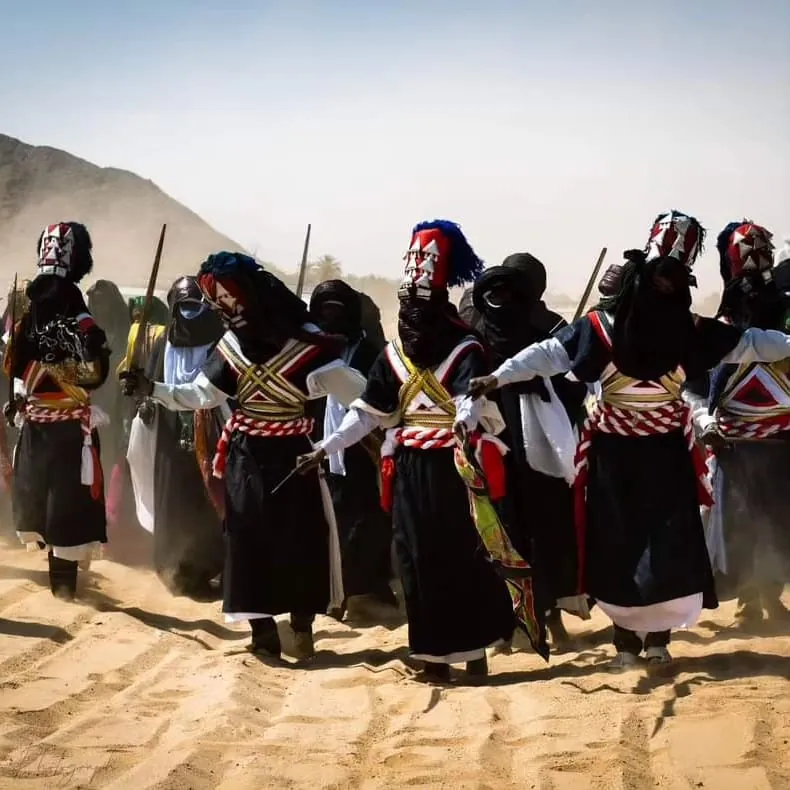
- Sebeiba in Djanet: a Tuareg ceremony of drums and dance held each year during the days of Ashura.
- The Sbuâ of Timimoun: a week-long annual pilgrimage in the Gourara, with Ahellil singing.
- Yennayer, the Amazigh New Year, on 12 January — a public holiday since 2018.
- Ramadan and the Eids: evenings come alive after the fast is broken; many sites keep shorter hours.
- Regional festivals such as the Ghardaïa carpet festival in spring and music festivals in Algiers, Oran and Timgad. Dates change each year — ask us when you plan.
Travelling respectfully
- Dress modestly in towns and religious places (shoulders and knees covered).
- Ask before photographing people. In the holy towns of the M'zab, photographing residents is not permitted.
- Never touch, wet or chalk rock paintings, and do not remove stones or artefacts.
- Use your right hand to eat and to give or receive, and accept tea when offered.
Last reviewed: 20 October 2026