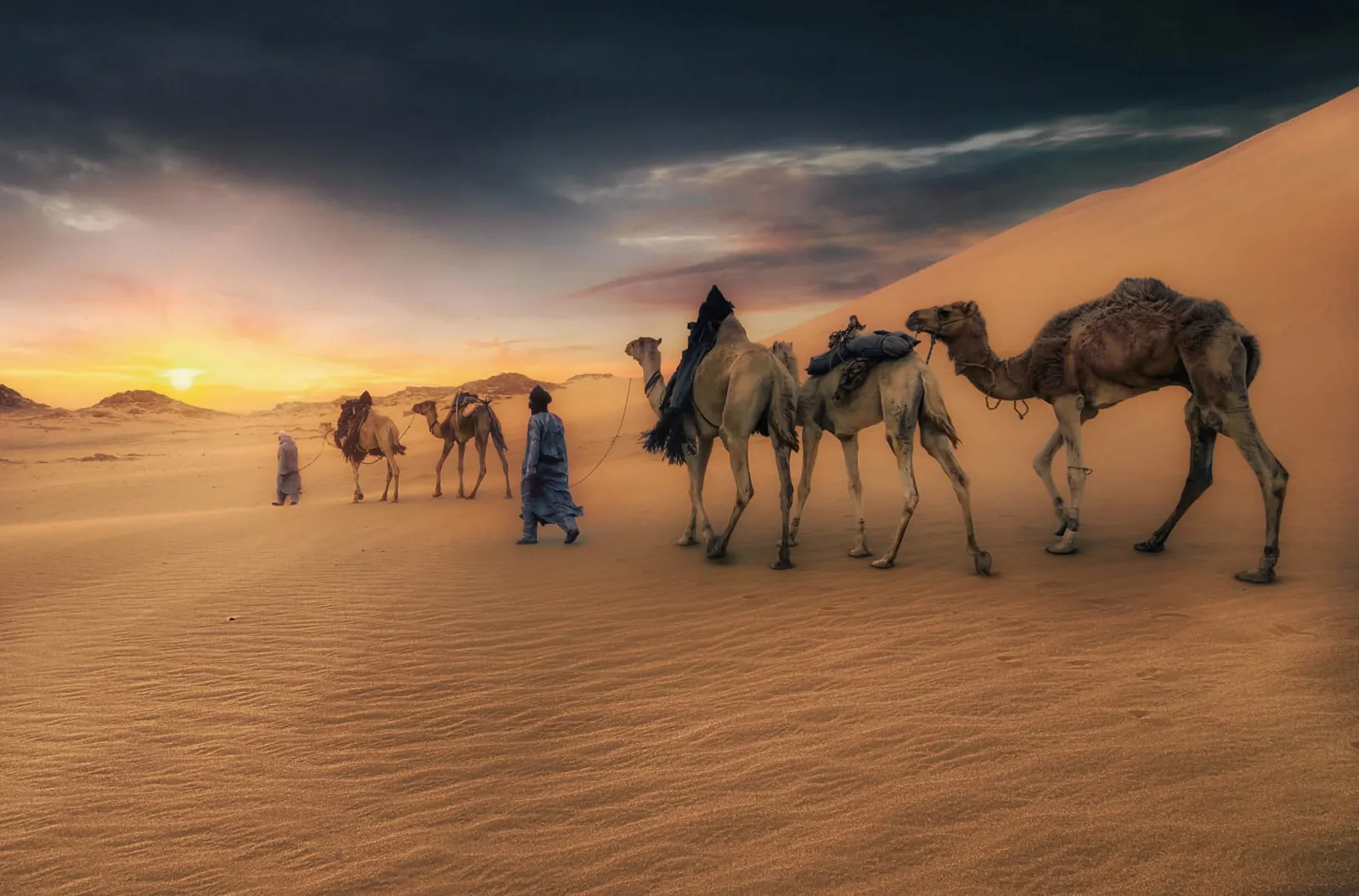
People often imagine the Sahara as a single sea of dunes. In Algeria, which holds the largest share of the desert, it is closer to a continent of its own. Over a few hundred kilometres you can pass from a stone forest to a red erg, from a volcanic massif to an oasis of mud-brick towers. Here are the five faces of the Algerian Sahara, and how our team explores each one.
1. The stone labyrinth: Tassili n'Ajjer
Above Djanet, the Tassili plateau looks like a ruined city: corridors, towers and arches of sandstone, sculpted by wind and ancient rivers. It is also one of the richest open-air galleries of prehistoric art on earth. The best way to experience it is on foot: a multi-day trek, with donkeys carrying the camp, to sites such as Sefar, Jabbaren and Tin Tazarift. Nights are spent among the rocks, around a fire, under a sky so dark the Milky Way casts a glow.
How to go: October to April, five days or more from Djanet. See the Tassili n'Ajjer guide.
2. The red desert: the Tadrart Rouge
Further south-east, near the Libyan border, the Tadrart is where the sand turns red. High dunes lean against cliffs and needles, natural arches frame the horizon, and side canyons hide engravings of giraffes and crocodiles from a time of lakes. The Tadrart is explored by 4x4 with daily walks; it requires no special fitness and offers some of the most photographed landscapes in Africa.
How to go: four to five days from Djanet. Read why choose the Tadrart Rouge.
3. The black mountains: the Hoggar
Around Tamanrasset, the desert rises into volcanic mountains. Basalt needles, organ-pipe columns and high plateaus culminate near 3,000 m. The Assekrem, where Charles de Foucauld built his hermitage in 1911, offers one of the most famous sunrises of the Sahara. This is also the heartland of the Kel Ahaggar Tuareg, whose tea ceremonies, silverwork and imzad music are part of any visit.
How to go: five to six days from Tamanrasset. See the Hoggar guide.
4. The sand seas: the Grand Erg Occidental
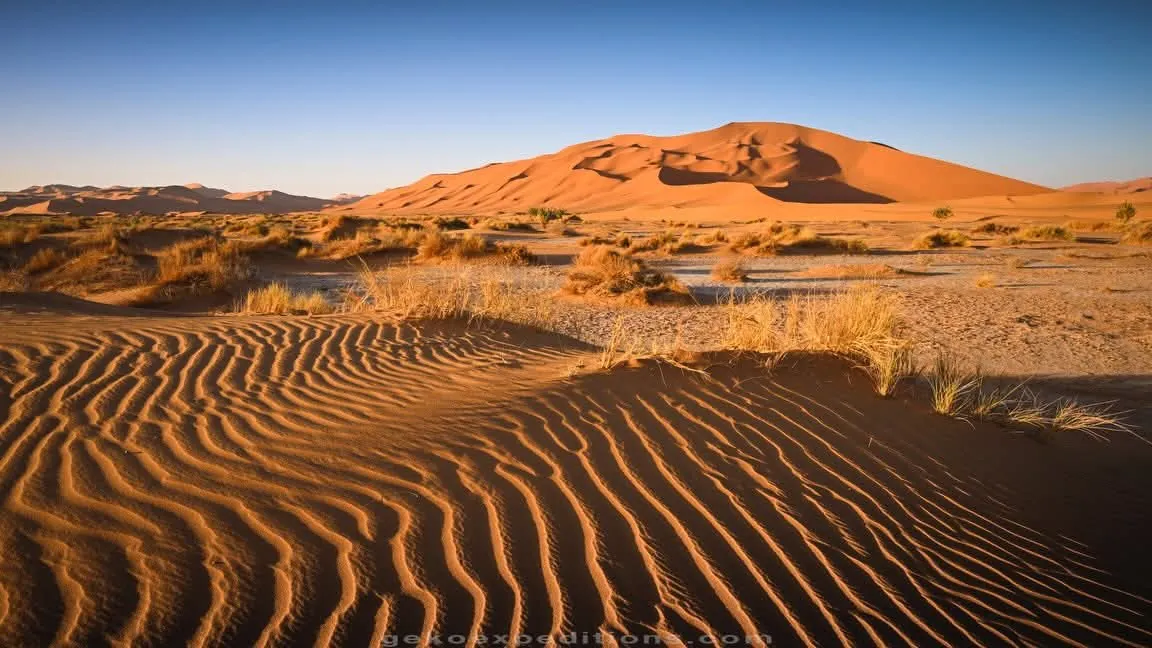
In the west, the Grand Erg Occidental covers some 100,000 km² of dunes. At Taghit, its ridges rise directly behind a palm grove and a restored ksar: you can walk from your guesthouse to the top of a dune in twenty minutes. Further south, the erg borders the Gourara and the red oasis of Timimoun. This is the most accessible great desert in Algeria — ideal for a first experience or a short extension.
How to go: three or four days via Béchar for Taghit. See the Taghit and Timimoun guides.
5. The oasis cities: the M'zab and the Gourara
The Sahara is also a human landscape. In the M'zab Valley, five towns built from the 11th century around their mosques still function as they did for centuries, with water shared between gardens by ingenious dams and channels. In the Gourara, foggaras carry water underground to palm gardens, and the Ahellil chants echo during celebrations. These oases show how people have lived in the desert with intelligence and restraint.
How to go: three to four days in Ghardaïa. See the M'zab guide.
Travelling responsibly in the desert
- Travel with local guides and crews: they know the routes, and tourism income stays in the region.
- Take all rubbish back, including cigarette ends and paper.
- Never touch, wet or chalk rock art, and never pick up artefacts — exporting them is prohibited.
- Ask before photographing people, and respect local customs.
- Check your government's travel advice: several governments advise against travel to parts of the far south (see our safety summary, checked 19 October 2026).
Which desert for you?
For trekking and rock art, choose the Tassili. For pure beauty, the Tadrart. For mountains and Tuareg culture, the Hoggar. For a short first taste, Taghit. For architecture and oasis life, the M'zab and Timimoun. Many travellers combine two: for instance the Tassili and the Tadrart over ten days from Djanet. Read how to plan a Sahara experience next.
Sources: UNESCO World Heritage Centre — Tassili n'Ajjer and M'Zab Valley; UNESCO Intangible Cultural Heritage lists (Ahellil of Gourara; practices related to the imzad); UK FCDO, US Department of State and France Diplomatie travel advice for Algeria, consulted 19 October 2026.